

When people talk about breakthroughs in 3D printing, the spotlight almost always lands on hardware — bigger printers, stronger materials, faster extrusion systems. But the real transformation in additive manufacturing isn’t happening inside the machines at all. It’s happening inside the software that tells them what to do.
While there’s no single product called “Innovations in 3D Printing,” the phrase represents a new generation of intelligent digital tools that have become the real drivers of progress. These platforms act as the brainpower behind modern printers, unlocking capabilities that simply weren’t possible a few years ago.
Below is a look at the software revolution that’s reshaping what 3D printing can achieve.
1. Generative Design: When AI Becomes the Engineer
Traditional CAD design relied on manual modeling. Engineers would sketch a part based on experience and refine it through trial and error.
Today, software such as Autodesk Fusion 360, nTopology, and other generative-design platforms flip that workflow on its head.
Instead of drawing a part, engineers define the requirements:
- “It must hold 50kg.”
- “It must fit inside this envelope.”
- “It must weigh under 200g.”
AI takes over from there, generating thousands of design variations automatically. These designs often resemble organic structures — shapes that seem grown rather than drawn — because the software optimizes geometry at a level far deeper than a human can.
Companies using generative design routinely cut material usage by 30–40% while improving strength and performance, especially in aerospace, automotive, and robotics.
2. Intelligent Slicing: The Translator That Thinks for Itself
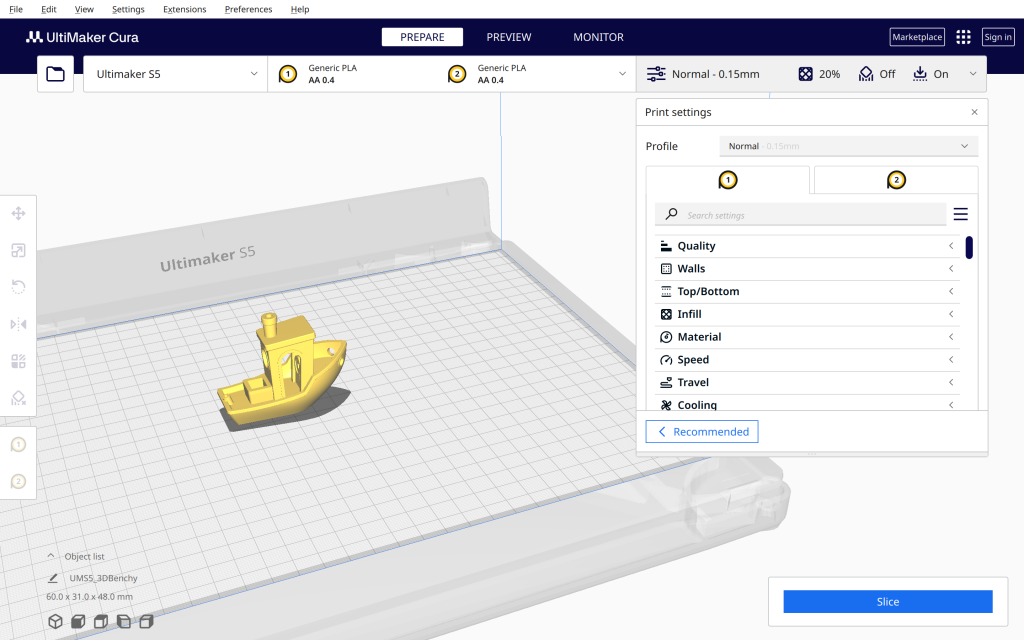
Once a model exists, slicing software converts it into thin layers the printer can build.
Older slicers treated every part of a model the same. Modern intelligent slicers don’t.
Adaptive Slicing
New slicing engines analyze geometry and automatically adjust:
- Thicker layers for simple, vertical surfaces to speed up printing
- Thinner layers for curved or detailed areas to preserve accuracy
Smarter Infill
Advanced algorithms now tailor internal structures using stress simulations. The part becomes dense where strength is needed and sparse where it’s not — reducing weight, saving material, and shortening print times.
Tools like Cura, PrusaSlicer, and industrial platforms are pushing this evolution forward.
3. In-Situ Monitoring: The AI Guard Dog
Few things frustrate makers more than returning to a printer after hours only to find a tangled mess of filament.
This is where computer-vision monitoring software such as Obico (formerly The Spaghetti Detective) steps in.
Using machine learning and a live camera feed, the system continuously compares the print’s progress to the original G-code. If it detects problems like:
- layer shifts
- warping
- bed detachment
- sudden spaghetti-like extrusion
… the software immediately pauses the print and alerts the user.
For large-scale operations running dozens or hundreds of printers, these tools save enormous amounts of time, material, and electricity.
4. Digital Twin Simulation: Fixing Problems Before They Exist
Metal additive manufacturing is powerful — but incredibly expensive. A failed titanium or Inconel print can cost thousands of dollars.
High-fidelity simulation platforms from ANSYS, Siemens, and others now create a Digital Twin, a physics-based virtual model of the entire printing process.
These tools simulate:
- laser heat absorption
- cooling rates
- thermal distortion
- residual stresses
Engineers can then modify the design before printing — even pre-warping the digital model so the final part contracts into the correct shape.
This level of prediction transforms metal 3D printing from risky experimentation into a controlled engineering process.
Conclusion: The Real Innovation Lives in the Code
3D printing hardware may be getting faster and stronger, but software is what’s unlocking the most meaningful leaps. AI-driven design, intelligent slicing, real-time monitoring, and advanced simulation have turned printers into smarter, more reliable tools capable of producing parts previously thought impossible.
In the new era of additive manufacturing, software is the architect, and the printer is simply the hands doing the work.